Showing posts with label canon. Show all posts

Wednesday, June 25, 2008

Photography nitty gritty #4: Aperture Part II

So we ended last time saying that you can't just run around changing your aperture willy-nilly. Well, I mean, you can... its your camera, you can do whatever the heck you want. but if you're going for a certain look, you can't. Why not? Because, aperture controls the "depth-of-field" in a photograph, and along with that, the bokeh.

Depth-of-field (or DoF from here on out) refers to how much of the photograph is in focus. When you focus on a certain object or area, there is a range both in front of and behind that point of focus that remains sharp. Your camera can only technically focus at one distance, and from there the sharpness fades into blurriness, both in front of and behind that point. How quickly it fades into blurriness is controlled by the aperture.

Very wide apertures (again, small number/large opening) have a narrow DoF. That means that when you focus on a single point there will only be a short distance in front of and behind that which will remain in focus. for example, with an aperture of 2.0 i can focus on kodiak's eyes and while they will be sharply in focus, his nose will be blurry.

Very small apertures have a much wider DoF. With an aperture of f/22, if i focus on kodiak's eyes, his nose will certainly be in focus. so will the fence behind him and probably the hospital across the street.

Not making any sense? How about a visual?

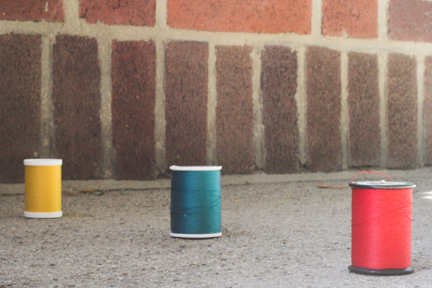
Let's start with f 2.0; this is a wide aperture and therefore a narrow depth of field


first we focus on Ms. Scarlet here in the front. as you can see, Mrs. Peacock is blurry, and Col. Mustard is blurrier yet. That's because the focus is in the front, and the subjects get blurrier the farther they are from the plane of focus.


now, if we focus on Mrs. Peacock, the focus is in the center and both Ms. Scarlet and Col. Mustard are equally blurry as they are both equal distance from the plane of focus. (more or less, i didn't bother with the ruler)
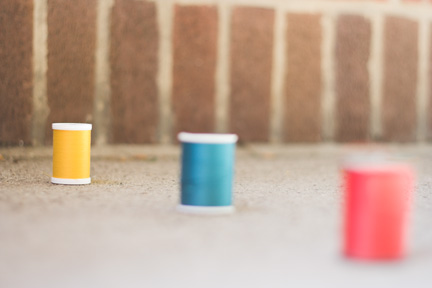

and lastly, focusing on Col. Mustard gives us the exact opposite of the first photo. In this case, Ms. Scarlet is the blurriest since she is the farthest from the plane of focus.

Now lets look at a small aperture, f 22, which gives us a much wider DoF.

focused on Mrs. Peacock

focused on Ms. Scarlet

focused on Col. Mustard

As you can see, it doesn't really matter who I focused on. At such a small aperture, all three of them are in focus, regardless of where the actual plane of focus was.

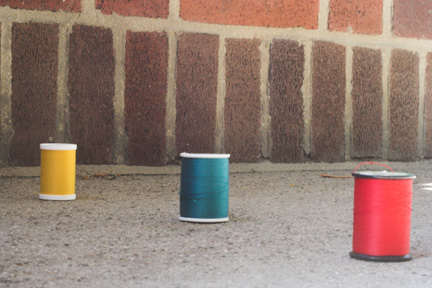
Your depth of field is also determined by how far away you are from whatever you focused on. in the following two images, Col. Mustard remained in the same place, only the camera moved. the aperture was f 2.0 for both pictures.
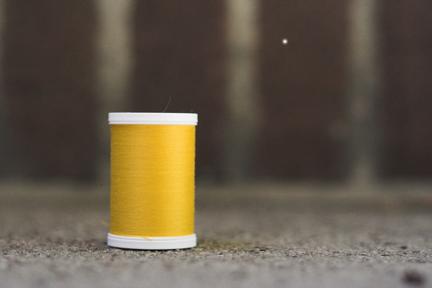
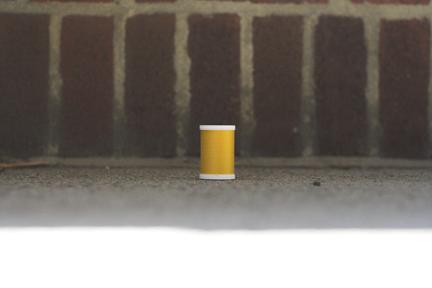
Notice in the first picture that the brick in the background, while still recognizable, is pretty blurry. In the second picture, even though the distance between the wall and Col. Mustard hasn't changed, the brick is much clearer. This is because in the first picture the two distances are almost equal, whereas in the second picture the wall is much closer to the Col. than the camera was.

So depth-of-field refers to how much of the image is in focus. what about the part that's not in focus? that, my friends, is bokeh. and that is my favorite part of photography. bokeh is that beautiful blurry background you get with a wide aperture.
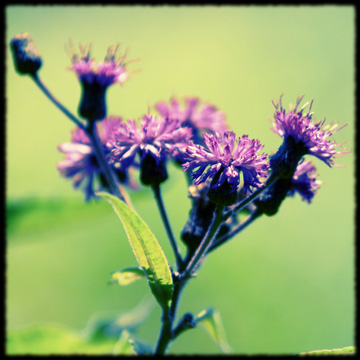

the area behind this flower was all sorts of bushes, grasses, and plants. had i used a smaller aperture, it would have been visible and very distracting. but by opening up to a wider aperture, it all blurred out into a soft, green haze.

the point...

if you're wondering what all this means to you, here's how to apply it to your pictures.
  • if you want a nice blurry background, you need a wider aperture
  • for more blur, move your subject farther away from whatever is in the background and move closer to your subject.
  • if you are taking a picture of two kids (for example) and one is sitting slightly in front of the other, you may need to stop down a little bit (one or two f-stops) so that both subjects are in focus.

um, yeah. that's all i can think of to say about aperture and DoF for now. Here's something to ponder until next time. If you think you know the answer, feel free to chime in. What if you have decided an aperture of f 2.8 gets you the nice blurry background you want when taking pictures of your little one(s), but your exposure meter says that such a wide aperture will cause your picture to be terribly overexposed. What to do?

p.s. Canon, don't forget to send me that 24-70mm L lens to review. Canon? Can you hear me??

Proceed to #5 Shutter Speed and Motion Blur

Monday, June 23, 2008

Photography nitty gritty #3: Aperture Part I

Before we get into the photography, there's a few other bits of housekeeping to discuss.

First of all, I am delighted to be the recipient of a Sunday Shout-out by Meghan of AllMediocre.com. If you haven't checked out AllMediocre, you should. Its a collection of lots of entertaining blogs by regular folks who are pretty funny. Tons of good stuff there. Secondly, if you made it here from Meghan's link, thanks for stopping by. The links to earlier posts in the photography series are over to the side there. feel free to say hi and ask questions if you're curious. if you're just reading for the first time, this series of posts is aimed at folks who got tired of crummy shots from their digital point-and-shoots and bought nice digital dslr's only to find out they have no idea what most of the buttons on their new camera do.

and lastly, since some people seem to have had some luck begging for cameras online, Canon... if you're listening i'd LOVE to tell anyone reading this blog how wonderful my new 24-70L glass is. Feel free to send it to me at any time. mkay, thanks.

Aperture

Ok, so we said there were three components that could be manipulated to control exposure. I wavered back and forth for a while trying to decide on which one to start with, but in the end decided on aperture, mainly because i'd already taken the demonstration pictures. And aperture can be the most confusing (at least it was for me) so you can chew on this one for a while without everything else already clouding things up.

The shutter is the part of the camera lens that opens and closes when you take a picture. Aperture (also known as f-stop) refers to how large, or small, that opening is. It is indicated by a number, often preceded by the letter f. for example f2.8 or f16. To demonstrate what it is, do this... Put your camera on aperture-priority (dust off the manual if you need to) and set your aperture to the lowest number you can. My 50mm goes down to 1.8... 3.0 is fine, so is 5.6. whatever.

Now, hold it out in front of you so you are looking into the lens. Like you're going to do that thing where you hold the camera out with the lens facing you, to take a self-portrait . Then press the shutter button and watch what happens inside the lens. did you see the shutter close? notice the size of the opening in the center. now change your aperture to the highest number it will go to, most likely 22. do the same thing. see the difference??

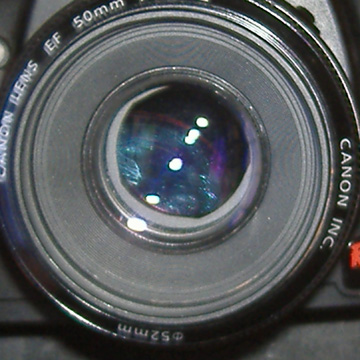
i used to know what the aperture actually was. its not really important so i forgot it... it has something to do with the diameter of that opening and how it relates to the focal length of the lens, in other words "math stuff." not important. what is important to know is that the smaller the number, the bigger the opening is. for instance, when you looked in your lens, the opening at f3.5 (or f5.6) should have been significantly bigger than it was at f22. right? remember that... it will make things easier later. just in case you didn't do the experiment, this is what it would have looked like.

f 2.0

f 5.6

f 22

So how does that relate to exposure?? Light. If all other setting remain the same, a larger aperture (i.e. bigger opening but SMALLER number) will let in more light than a smaller aperture (i.e. smaller opening but bigger number). so if your camera is set to automatic and its a very bright sunny day, your camera will likely choose a smaller aperture. think about it... lots of light means risk of over exposure. to cut down the light getting in, we make a smaller opening. this is called "stopping down." think of it like your eye. in very dim lighting your eye dilates (to approximately f2.3) and in bright daylight in constricts, or stops down, if you will.

time out... are you thoroughly confused yet? feel free to ask for clarification because it only gets murkier from here.

So why change your aperture? Why not just let the camera pick whatever aperture it thinks is right for the lighting situation? Because changing the aperture has a huge impact on the final result of your picture. Aperture influences how much of the picture is in focus, and how much is out of focus. This is called depth-of-field. We'll save that for next time, so as not to overwhelm...

Continue to Part 4: More aperture